Login Facebook Register

Touring Italy - Great travel tips, tours

» Home » Latium » Etruscan Road Trip: Rome to Rome    ||     » BACK

ETRUSCAN ROAD TRIP: ROME TO ROME
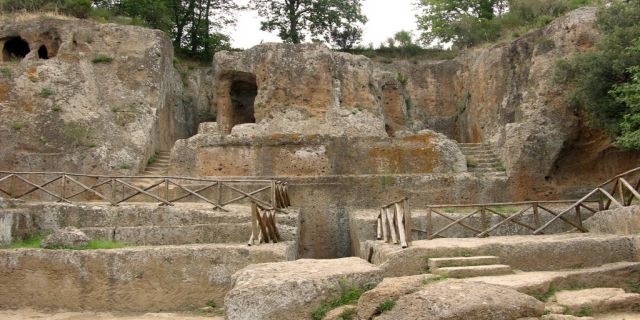
Etruscan Road Trip: Rome to Rome


Following the Etruscans: A Complete Circular Travel Guide from Rome across Central Italy

Itinerary:
Etruscan Road Trip: Rome to Rome
Silent Legacy of Etruria:
Before Rome extended its empire across the Mediterranean, central Italy was dominated by a confederation of cultured, refined, and deeply spiritual city-states: the Etruscans. Flourishing between the 8th and 3rd centuries BCE, the Etruscan civilization left no epic literature, yet they carved their identity into the earth, the stone, and their art.

What the Etruscans passed down to us is a unique heritage characterized by an extraordinary sense of humanity:
The Afterlife as a Celebration: Unlike other ancient cultures, the Etruscans did not view the transition to death as a dark condemnation, but rather as a continuation of earthly pleasures. Their necropolises are not monuments to sorrow, but homes for eternity filled with colors, dancing, and banquets. Female Emancipation: In Etruscan society, women enjoyed a level of freedom and dignity unknown in the Greek and Roman worlds. They participated in banquets reclining right next to their husbands, were literate, owned property, and passed their family names down to their children.

Engineering and Harmony with Nature: Absolute masters of water management and metallurgy, the Etruscans knew how to seamlessly blend the natural landscape with the sacred. The pathways carved into the tuff rock and the cities molded onto cliffs demonstrate an almost mystical respect for the topography of the land.

This journey is a loop through time across Lazio, Tuscany, and Umbria, leading us back to the deepest roots of Italian culture.
Etruscan Road Trip: Rome to Rome - Pic 7
The Great Etruscan Ring: A Travel Guide:
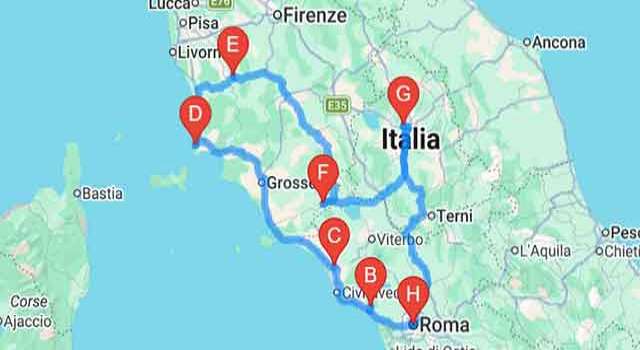
[Rome] ➔ [Cerveteri] ➔ [Tarquinia] ➔ [Populonia/Baratti] ➔ [Volterra] ➔ [Pitigliano/Sovana] ➔ [Perugia] ➔ [Rome] Step 1: Cerveteri – The City of the Dead That Mimics the Living
From Rome: ~45 km along the Via Aurelia and A12/E80 heading northwest.

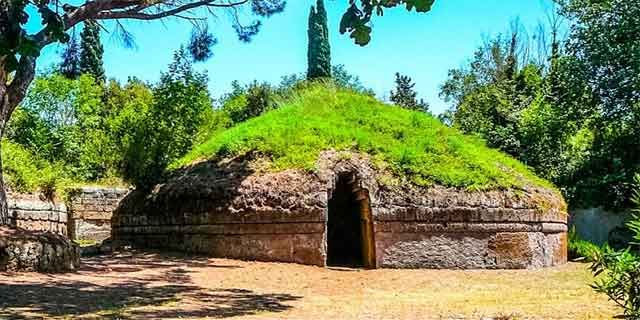
The journey begins by leaving Rome behind and setting off for the Banditaccia Necropolis in Cerveteri (ancient Caere). This UNESCO World Heritage site is the largest necropolis in the Mediterranean basin. Walking here means traversing actual city streets flanked by Tumuli—monumental circular tombs carved out of the tuff rock and topped with mounds of earth.

The internal architecture of these tombs faithfully reproduces the homes of the living, complete with gabled ceilings, beds carved into stone, and pillars. The absolute highlight of the visit is the Tomb of the Reliefs, where the walls are decorated with colorful stuccoes depicting household items, ropes, knives, and even pets, ensuring the deceased enjoyed all the comforts of their earthly life. Before moving on, a stop at the National Archaeological Museum inside Cerveteri's medieval hamlet lets you admire the funerary goods and pottery unearthed in the area.

Step 2: Tarquinia – The Underground Art Gallery
From Cerveteri: ~53 km north along the A12/E80.

Continuing up the Laziale coast, you will reach the Monterozzi Necropolis in Tarquinia. While Cerveteri awes visitors with its grand architecture, Tarquinia enchants them with its colors. This site preserves the most significant collection of ancient Etruscan paintings in the world.

As you step down into the various underground tombs—carefully protected by glass barriers to maintain their microclimate—you will look out onto millennia-old masterpieces: the Tomb of the Leopards, the Tomb of the Lionesses, and the Tomb of Hunting and Fishing. The frescoes portray flute players, dancers, divers, and bancheters crowned with ivy with incredible vitality. In the town center, inside the spectacular Palazzo Vitelleschi (National Archaeological Museum), you will stand in awe before the Winged Horses, a terracotta relief masterpiece that stands as a symbol of Etruscan sculptural art.

Step 3: Populonia and Baratti – Etruria by the Sea
From Tarquinia: ~165 km north along the SS1 Aurelia.

We leave Lazio and cross into Tuscany to reach the Archaeological Park of Baratti and Populonia. Populonia (Fufluna) was the only major Etruscan city built right on the coastline, established to control the trade and smelting of iron extracted from the nearby rich deposits on the Island of Elba.

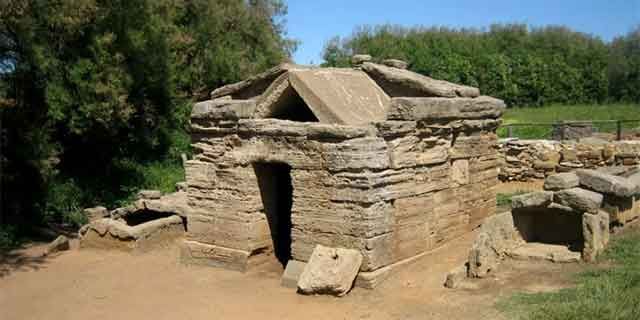
The site offers a stunning color contrast between the green Mediterranean scrub, the deep blue of the gulf, and the dark, shiny iron slag that still glints on the beach. In the lower section (San Cerbone), you can walk right next to the beach among edicola and chest tombs dating back to the 7th–6th centuries BCE. Heading up to the high Acropolis, you will wander through the remains of temples overlooking the promontory, offering a breathtaking view that stretches across the entire Tuscan Archipelago.

Step 4: Volterra – The Alabaster Fortress
From Populonia: ~76 km inland along the SS68 Val Cecina.

We turn away from the coast to venture deep into the Pisani hills, climbing 500 meters up to Volterra (Velathri), one of the most powerful and impregnable city-states of the Etruscan Dodecapolis. Protected by sheer rock faces and striking badlands, the city still features the imposing Porta all'Arco (Arch Gate) from the 4th–3rd century BCE, whose jambs hold three mysterious stone heads weathered by time.

The unmissable destination here is the Guarnacci Etruscan Museum, one of the oldest public museums in Europe. Inside, you will find the Shadow of the Evening (L'ombra della sera), an extraordinarily elongated, wire-like bronze votive statuette that later fascinated Giacometti, and the Urn of the Spouses, a terracotta lid depicting an elderly couple linked by a deeply touching, lifelike gaze—a true reflection of the mutual respect typical of Etruscan society.

Step 5: The Tuff Area – Pitigliano and Sovana
From Volterra: ~215 km southeast, heading back into the inland Maremma.

The journey turns intimate and mystical as you enter the Tuff Area. Pitigliano welcomes you with a fairytale sight: an entire medieval town that appears to grow seamlessly out of a massive volcanic tuff cliff, suspended in mid-air.
Hidden in the surrounding woods near nearby Sovana is the most spiritual side of the Etruscan world: the Vie Cave (Sunken Roads). These are cyclopean road networks, real trenches carved entirely by hand out of the tuff rock using bronze and iron picks. Walking in the absolute silence of the Cavone or the Via Cava di San Giuseppe, between vertical rock walls over twenty meters high covered in moss and ferns, evokes ancient sacred rituals and processions. In Sovana, the monumental Ildebranda Tomb will strike you with its temple-like facade carved directly into the cliffside.

Step 6: Perugia – Urban Engineering
From Pitigliano: ~110 km east, skirting Lake Trasimeno.

We cross the regional border into Umbria for our final major stop before heading back: Perugia. Here, the Etruscans showcase their incredible urban planning and monumental engineering in the middle of a living city.

The historic center is still encircled by its original Etruscan walls, featuring the grand Etruscan Arch (or Arch of Augustus), a monumental gateway perfectly preserved with its mortarless travertine blocks. But the true engineering marvel lies hidden underground: the Etruscan Well. This 3rd-century BCE hydraulic structure plunges roughly 37 meters down, designed to secure the city's water supply by tapping into underground veins—a public work that testifies to an extraordinary technological mastery.

The Return to Rome
From Perugia: ~170 km south along the E45 and the A1 highway.

Driving down through the Tiber Valley, the journey concludes as you return to Rome. You will have completed a perfect loop, both geographically and historically: the very path of cultural integration that saw the Etruscan civilization progressively merge with the Roman world, leaving us their symbols, their architectural techniques, and that unbreakable bond between art, beauty, and landscape that still defines the heart of Italy.
Tour on map

Photo gallery

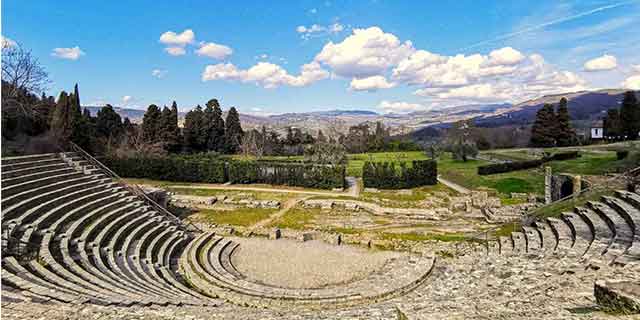
Tour in Italy: Etruscan Road Trip: Rome to Rome - pic 1
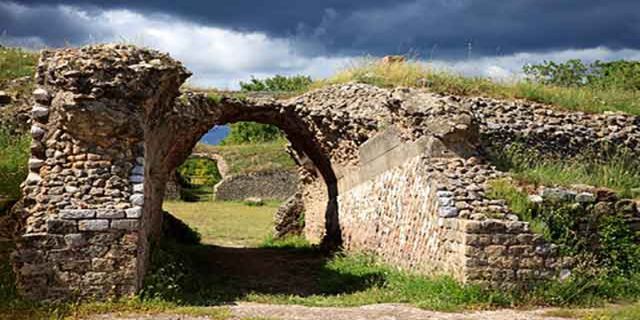
Tour in Italy: Etruscan Road Trip: Rome to Rome - pic 2
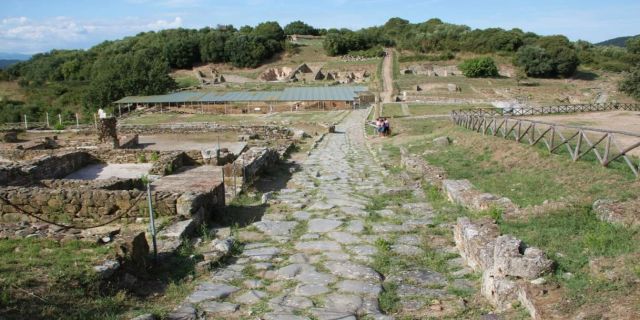
Tour in Italy: Etruscan Road Trip: Rome to Rome - pic 3
Tour in Italy: Etruscan Road Trip: Rome to Rome - Pic 4
Tour in Italy: Etruscan Road Trip: Rome to Rome - Pic 5
Itinerary map

Tour map

Etruscan Road Trip: Rome to Rome - Mappa

Top

Id: 248

Tour: Etruscan Road Trip: Rome to Rome

Category: Country sightseeing tour

Published by/Copyright: Touring-Italy.net

Location: Countryside

Region: Latium , Italy

Area: Versilia

Hits: 219

» Liability disclosure

» Copyright

Tours by region

Click on a region to see all the tours for that area

Italy regions Aosta Valley & Aosta Piedmont & Turin Lombardy & Milan Trentino A.A.(South Tirol) & Trento Veneto & Venice Emilia Romagna & Bologna Liguria & Genoa Tuscany & Florence Marches & Ancona Umbria & Perugia Latium & Rome Abruzzo & L'Aquila Molise & Campobasso Campania & Naples Apulia & Bari Basilicata & Potenza Calabria & Catanzaro Sicily & Palermo Sardinia & Cagliari Friuli V. G. & Trieste
top page